AI Hub

Exploring AI in Business: Insights, Ideas & Real-World Impact

Welcome to the Shinka AI Blog — your go-to spot for fresh, insightful takes on how AI is transforming business. Whether you’re running a small startup or scaling a growing brand, we dive into practical, real-world ways AI is streamlining operations, improving customer experience, and helping businesses grow smarter (not harder). From lead generation to language translation and beyond, we break down the tech without the jargon — so you can stay ahead of the curve, even if you’re not a tech expert.

How AI Can Help Struggling Restaurants and Bars Improve Performance

Running a restaurant or bar is never easy. Many businesses are now turning to creative solutions to boost sales and keep customers coming back. One promising approach is to use artificial intelligence (AI), and this post explores how AI can increase customer retention, improve satisfaction, and bring in new customers with smarter marketing.

Predicting Customer Preferences

AI tools can analyze past orders, seasonal trends, and even social media comments to predict customer preferences. By identifying popular dishes or spotting trends early, managers can adjust menus and services to match what guests crave. AI can also sift through online reviews to spot patterns – like frequent complaints – and show where operations need improvement. These insights lead to higher customer satisfaction, and 60% of people believe good service is key to keeping patrons loyal explodingtopics.com.

Automating Marketing Campaigns

AI can act as a smart marketing assistant, helping with both customer retention and lead generation. It allows even a small team to automate outreach and promotions to reach customers at the right time. For example, an AI system might email a special discount to a customer who hasn’t visited in a while to win them back. These tools can also find new potential guests by identifying people similar to your best customers. This focused marketing saves time and money while boosting results. About 33% of restaurants plan to use AI for customer marketing restaurant365.com.

Personalizing Offers to Increase Loyalty

Personalization is one of AI’s biggest strengths. AI learns from a guest’s past orders to tailor recommendations and special offers. For instance, a loyal diner might get a deal on their favorite dish, while a bar patron receives tailored drink suggestions based on their preferences. In fact, 62% of business leaders say AI-driven personalization has improved customer retention contentful.com. When guests feel understood, they are more likely to become regulars – and loyal regulars often make up the bulk of a restaurant’s revenue restaurantdive.com.

Conclusion

Adopting AI can give struggling restaurants and bars a boost. By predicting customer needs, automating marketing, and personalizing the experience, AI helps keep guests happy and coming back. Even a modest increase in customer retention can have a big impact – just a 5% increase can lift profits by 25% restaurantdive.com. Embracing AI can help these businesses not just survive but thrive, turning casual visitors into loyal regulars.

Sources:
restaurantdive.com contentful.com explodingtopics.com restaurant365.com

AI’s Next Big Leap: From Chatbots to Real-World Sidekicks

Artificial intelligence is evolving from a text-based whiz into something far more tangible and exciting. Over the next decade, one of the most thrilling advancements in AI will be systems that can see, hear, and act in the real world—essentially giving AI “eyes and hands.” Instead of just chatting or analyzing data, future AI could interact with our environment as a helpful sidekick. Imagine telling a digital assistant to tidy up your living room or fetch a snack, and it understands you and physically makes it happen. This leap is grounded in current research and developments, not just science fiction, making it all the more exhilarating.

One AI, Many Talents

Already, prototypes of these versatile AI systems are emerging. For example:

  • Follow complex instructions: Google’s PaLM-E model guided a robot to fetch a bag of rice chips from a drawer just by understanding a human request palm-e.github.io. The same AI could also describe what it sees or answer questions about images – all in one package.
  • Multitask across domains: DeepMind’s Gato AI was dubbed a “generalist agent” for its ability to carry out a huge range of complex tasks, from stacking blocks to writing poetry en.wikipedia.org with a single neural network. One brain, many skills!

These early projects hint at what’s coming. Tech experts predict that by 2035, such AI helpers will be woven into daily life – perhaps via smart glasses or earbuds connecting us to an ever-present digital helper pewresearch.org. In other words, we’re looking at a future where everyone can have an intelligent, proactive assistant at their side. From helping with household chores to providing real-time information and guidance, AI sidekicks promise to make our lives easier and more interesting. It’s an energetic new frontier for AI, and it has us very curious and excited for what’s next!

Sources: Current AI research initiatives and expert predictions palm-e.github.io en.wikipedia.org pewresearch.org.

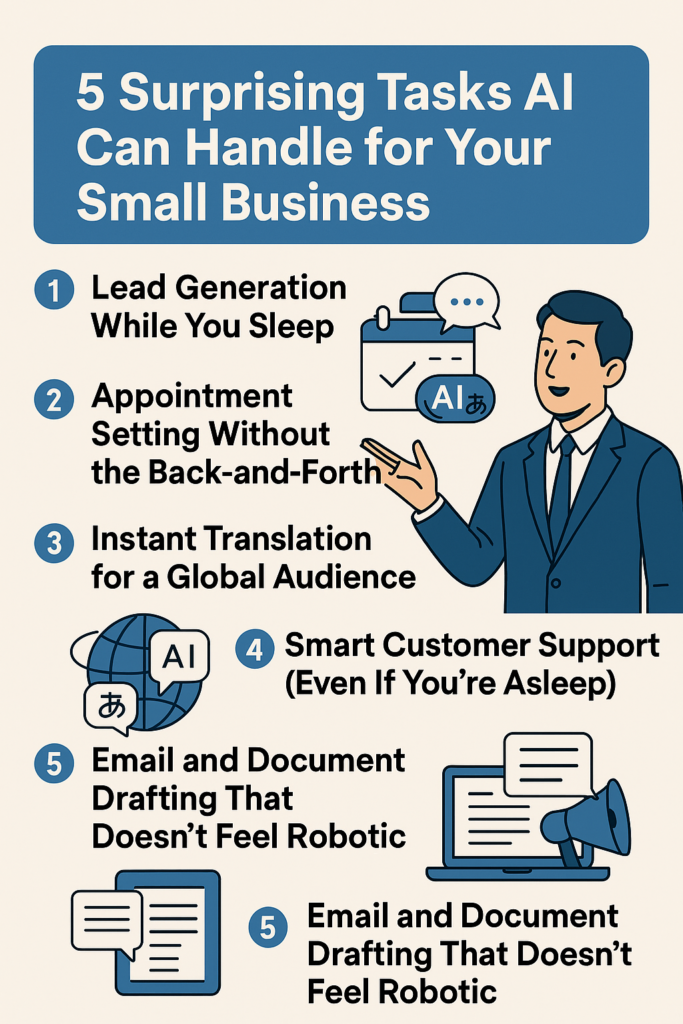
5 Surprising Tasks AI Can Handle for Your Small Business (That You’re Probably Still Doing Manually)

Running a small business means wearing a dozen hats — often all at once. But what if you could hand off some of the more repetitive or time-consuming tasks to a digital assistant that works 24/7 and never takes a break?

AI isn’t just for big corporations anymore. With the right setup, even solo entrepreneurs or small teams can use artificial intelligence to save time, reduce stress, and grow faster. Here are five surprising things AI can do for your business — and why you might want to bring in an expert to help implement them.


1. Lead Generation While You Sleep

AI can automatically identify potential customers, sort them by quality, and even send the first outreach message. Imagine your inbox filling up with warm leads without you lifting a finger. Tools can scan websites, social media, and other platforms to find ideal clients — especially useful for freelancers, consultants, and local businesses.


2. Appointment Setting Without the Back-and-Forth

AI schedulers don’t just send calendar links — they can hold natural conversations, understand preferences, and confirm bookings. Perfect for busy service-based businesses where time is money and missed appointments mean lost revenue.


3. Instant Translation for a Global Audience

Serving international clients? AI translation tools can help you communicate professionally and clearly, breaking down language barriers in emails, product descriptions, or support messages. It’s faster and cheaper than hiring full-time translators — and surprisingly accurate when set up well.


4. Smart Customer Support (Even If You’re Asleep)

AI-powered chatbots can now answer common questions, troubleshoot simple problems, and route urgent issues to your phone. Your customers get help faster — and your stress levels drop.


5. Email and Document Drafting That Doesn’t Feel Robotic

AI tools can generate first drafts for proposals, social posts, blog outlines, or even contracts. No more starting from scratch every time — you just edit and personalize.


A Word of Caution: Don’t DIY Everything

While these tools are powerful, they’re not always plug-and-play. Misconfigured AI can confuse customers or miss opportunities. That’s why hiring an AI consultant or specialist (even part-time) is often essential. The learning curve is real — but with the right support, the payoff is huge.

AI isn’t just a trend — it’s a competitive advantage. The question is: Are you ready to put it to work for your business?

The New AI Divide: Why Some Small Businesses Will Leap Ahead — and Others Will Be Left Behind

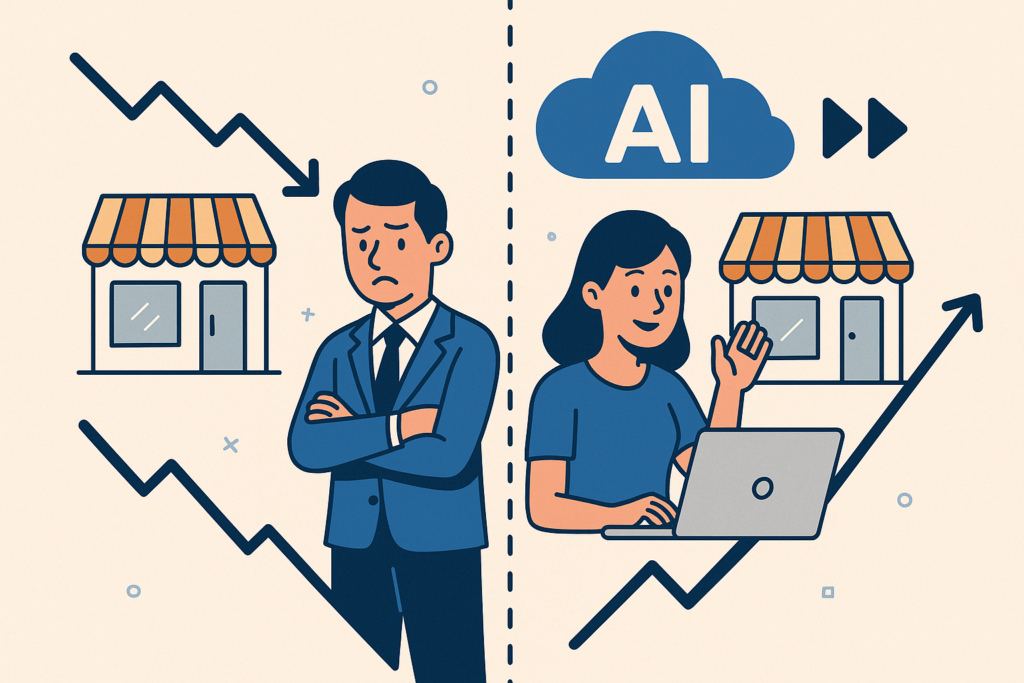
A Digital Divide Among Small Businesses

The great AI Divide

A new “AI divide” is emerging in the small business world. This isn’t just the old gap between big companies and mom-and-pop shops – it’s a divide within the small business community itself. On one side are the savvy early adopters of artificial intelligence, already streamlining operations and wowing customers. On the other side are those taking a “wait and see” approach. The difference is growing more pronounced every day. In fact, one recent report found that 94% of small businesses plan to incorporate AI into their operations in 2024linkedin.com. The message is clear: nearly all your peers are exploring AI, and if you’re not, you could be left on the wrong side of this divide.

Early Adopters Reaping the Benefits

Small businesses embracing AI early are seeing significant advantages. They’re using AI tools to automate mundane tasks, gain insights from data, and respond to customers faster. This means leaner operations, quicker service, and often lower costs. For example, an owner might use AI to automatically sort customer emails or manage inventory levels in real-time. These enhancements free up time to focus on growth and customer relationships. Early adopters often describe AI as a “force multiplier” – it’s like having extra hands (or an extra brain) in the business. It’s no surprise that many who leverage AI report improvements in efficiency and customer satisfaction. (One survey noted that about 72% of small businesses using AI-driven customer support see faster resolution times for customer issuescolorwhistle.com.) In short, the businesses jumping on AI are working smarter, not harder, and it shows in their bottom line.

Late Adopters Risk Falling Behind

Meanwhile, small businesses that ignore or delay AI adoption face growing challenges. As competitors become faster and more responsive thanks to automation, late adopters struggle to keep up. Routine tasks that could be automated eat up precious hours. Customer inquiries might go unanswered overnight while competitors’ AI chatbots handle questions 24/7. Over time, these differences add up. A client might choose a service provider who offers near-instant quotes or support (powered by AI) over one who doesn’t. The risk is that late adopters will appear less efficient, less attentive, and ultimately less competitive in the eyes of customers. The AI divide means that what was “good enough” service a year or two ago may now feel sluggish and outdated if your rivals have upgraded their capabilities.

Real-World Examples of AI in Action

To understand the divide, consider a few real-world style examples of how small businesses are using AI today:

  • E-commerce Shop with AI Chatbots: A small online retail shop deploys an AI chatbot to answer customer questions and help with orders 24/7. Shoppers can get instant responses at any hour, improving the shopping experience. The owner saves time on customer service, and no customer is left waiting. It’s paying off – surveys show that businesses using AI-driven customer support resolve issues much faster, keeping customers happier​ colorwhistle.com.
  • Solo Freelancer Leveraging AI: Imagine a freelance graphic designer who uses AI tools as a virtual assistant. They employ AI to schedule meetings, draft project proposals, and even generate initial design ideas. This freelancer can manage more clients at once because repetitive tasks are handled efficiently by software. As a result, they can take on new projects that a competitor (who does everything manually) might have to turn down.
  • Small Consultancy Analyzing Feedback: A boutique consulting firm uses AI to sift through client feedback and market research data. Instead of spending days reading surveys and reviews, they let an AI program summarize sentiments and highlight key trends in minutes. This means the firm can update strategies or solve client issues faster than rivals still sorting data by hand. Speedy insights give them a competitive edge – they’re proactive rather than reactive.

Each of these examples shows how adopting AI can help a small business punch above its weight. These aren’t sci-fi scenarios or something only giant corporations do. They’re happening now in the small business arena, and the businesses implementing such solutions are pulling ahead of those who aren’t.

Bridging the AI Divide

The good news is that it’s not too late for businesses on the sidelines to catch up. AI technology is becoming more accessible and user-friendly, with many tools designed for non-experts. Small business owners can start with modest steps – like automating a single task or experimenting with an AI-based service – to gradually build their AI capabilities. What’s important is developing an openness to new tech and a willingness to learn. In a sense, the biggest divider is mindset: companies that treat AI as a opportunity vs. those that shy away from it. By staying curious and proactive about these tools, any business can begin to close the gap.

In today’s fast-changing landscape, standing still is the same as moving backward. The AI divide will continue to widen between the quick adopters and the hesitant. The question is, which side of that divide will your business be on? Is your business adapting fast enough to stay on the right side of the AI divide?

AI-Powered Innovations

New Trends Reshaping SMB Customer Service and Automation

Small and mid-sized businesses (SMBs) are experiencing an AI-driven revolution in how they operate. AI is no longer just for tech giants; it’s now accessible and affordable enough that 98% of small businesses are embracing it in some formtranscribe.com. From enhancing customer interactions to automating tedious tasks, new AI trends are leveling the playing field and helping SMBs work smarter. Let’s explore two game-changing areas – customer service and operational automation – where AI is making a big impact.

AI-Powered Customer Service Innovations

Delivering great customer service is crucial for any business, and AI is taking it to the next level for SMBs. Thanks to advances in conversational AI, today’s chatbots and virtual assistants can handle complex customer questions around the clock, providing instant, consistent support and freeing human staff to focus on higher-value tasks​ transcribe.com. These AI-powered agents are more natural sounding and intelligent than the chatbots of a few years ago, so even a small team can offer 24/7 help without burnout. In fact, Gartner predicts that by 2025, 70% of customer interactions will be handled by AI technologies​ nice.com – a clear sign that tools like AI chatbots and voice assistants are becoming standard for customer engagement. The result for SMBs is faster responses, personalized service, and happier customers, all without needing a large call center.

Intelligent Automation Tools Transforming Operations

Beyond customer support, AI is streamlining day-to-day operations for SMBs through smart automation. Routine tasks like generating sales quotes, scheduling employees, and sending invoice reminders can now be automated with AIuschamber.com. By letting AI handle these repetitive chores, business owners and employees save time and reduce human error. This means more hours to focus on growth, creativity, and strategic work instead of paperwork. The impact is tangible – 90% of small businesses using AI report that it makes their operations more efficientuschamber.com. From managing inventory with predictive analytics to simplifying HR and accounting, AI-powered tools are helping smaller companies do more with less and operate like much larger enterprises. It’s quickly becoming clear that embracing automation isn’t just about efficiency, but a competitive necessity for the future.

SMBs have an exciting, AI-powered future ahead. Cutting-edge customer service bots and automation platforms are reshaping how businesses connect with customers and streamline their workflows, all in an optimistic, forward-looking way. The playing field is more level than ever as AI empowers businesses of every size to deliver better experiences and scale their success. What AI trend are you most excited to implement in your own business, and how do you see it transforming the way you work?

Why AI Is Becoming Essential for Small Businesses

AI to solve business problems

Introduction:
Imagine having an extra pair of hands in your business that works 24/7, never gets tired, and continually learns to do things better. That’s essentially what artificial intelligence (AI) offers to small and medium-sized businesses (SMBs). Once seen as a luxury or a high-tech experiment, AI is fast becoming a practical necessity for SMBs to remain competitive. With limited human capital and tight budgets, small businesses are discovering that AI can help them do more with less, driving efficiency, growth, and better customer satisfaction.

A Competitive Edge for SMBs

For many small businesses, the marketplace is tougher than ever. Customers expect fast service and personalized experiences, regardless of a company’s size. AI tools give SMBs a competitive edge by leveling the playing field. Why the growing need? Competitors (including other small businesses) are adopting AI to automate routine tasks, analyze data, and engage customers. Falling behind on technology can mean losing customers to faster or more responsive rivals. In fact, 86% of small businesses say AI has already made their operations more efficient​businesswire.com. When mundane tasks are automated – like data entry or sorting customer inquiries – your team can focus on strategic work and creative problem-solving. This boost in productivity is crucial for a small team wearing many hats.

Doing More with Less: Efficiency and Growth

SMBs often juggle many roles with few people. AI acts as a force multiplier for these teams. For example:

  • Customer Service Chatbots: AI-powered chatbots can handle common questions or support requests around the clock, keeping customers happy with quick answers even when you’re offline.
  • Automation of Repetitive Tasks: From scheduling social media posts to sending invoice reminders, AI can automate time-consuming tasks, reducing human error and freeing up hours for your staff.
  • Data Insights: AI analytics can sift through sales or website data and highlight trends, helping you make informed decisions swiftly.

All these help drive growth by improving efficiency and enabling a small business to serve more customers without a proportional increase in headcount. It’s no surprise that business owners using AI are optimistic about the future – over 90% believe AI will help their business grow​businesswire.com. By leveraging AI, even a 10-person company can punch above its weight, reaching a level of service and insight that used to be exclusive to big corporations.

AI Without the Intimidation

When some people hear “AI,” they picture complex robots or costly high-tech infrastructure. But AI for small businesses doesn’t have to be intimidating. There are plenty of lightweight, affordable AI tools available today. Many are as simple as adding a plugin or signing up for an online service – no PhD in computer science required. For instance, you can use an AI-based grammar assistant in your emails, or an inventory management tool that automatically reorders popular items. Importantly, these tools are budget-friendly: lots of AI services run on a subscription model, where you can start small (often even with a free tier or trial) and scale up as you see results. This means you can experiment with AI without a massive upfront investment. As one guide put it, you can start with basic features and gradually introduce more as you grow comfortable, all while monitoring the impact on your business.

Embracing AI as a Strategic Asset

The key takeaway is that AI is no longer a sci-fi idea reserved for tech giants – it’s a practical tool that any business owner can use. By thinking of AI as a strategic asset, SMBs can improve customer satisfaction (through faster responses and personalized service), streamline their operations, and find new growth opportunities. Whether it’s an AI scheduler that optimizes your appointments or a smart recommendation engine in your online shop, these technologies can help your business run smarter and compete harder. In the modern business landscape, integrating AI isn’t about replacing your team – it’s about empowering them. Small businesses that embrace AI now are positioning themselves not just to survive, but to thrive, in an increasingly digital and competitive world.

How AI Can Help Freelancers (Lead Generation)

For freelancers like personal trainers or personal chefs, finding new clients often feels like a full-time job on top of serving your current ones. Tasks like searching for prospects, sending introductory messages, and following up can eat up hours each week. Fortunately, AI-powered lead generation tools can act like a virtual assistant to take over these repetitive chores.

personal trainer leading yoga class in sunny park, clients following poses on mats, symbolizing AI-generated leads for freelancers; digital notification overlay — Shinka AI lead generation for small businesses.

AI Does the Busy Work

Think of AI as a tireless assistant that never sleeps. It can scan online platforms for potential clients and send a friendly introduction on your behalf​keepme.ai. It can also:

  • Finding prospects: Scanning social media or local websites to find people who need your services.
  • Sending introductions: Automatically sending a warm hello to introduce you and your services.
  • Following up: Checking back with people who haven’t responded.
    By automating these tasks, AI ensures you never miss a lead, working 24/7 so you don’t have to. ​giosg.com.

Focus on What You Love

With AI doing the grunt work, you have more time to spend training clients or crafting recipes instead of cold emailing. By automating lead tasks, professionals reclaim valuable time and can focus on what they do best. ​bardeen.ai – for you, that means delivering great workouts or meals, not chasing clients.

No Tech Skills? No Problem

Many AI lead generation tools (like Shinka AI’s) are easy to use. They can be implemented by an AI consultant and let them run in the background, bringing in new leads while you focus on your work.

AI isn’t replacing your personal touch – it’s freeing you from the boring bits of finding clients, giving you more time and energy for your real work (and even helping cut costs). It’s a supportive way to grow your freelance business faster and with less stress.